Many women considering breast augmentation share a similar goal: they want fuller, more attractive breasts without looking obviously augmented. One of the most common questions patients ask is whether breast implants can look natural and what factors influence the final result.
The answer involves much more than implant size alone. Breast shape, volume distribution, upper pole fullness, and individual anatomy all play a role in determining whether breast augmentation appears subtle and natural or more noticeably enhanced.
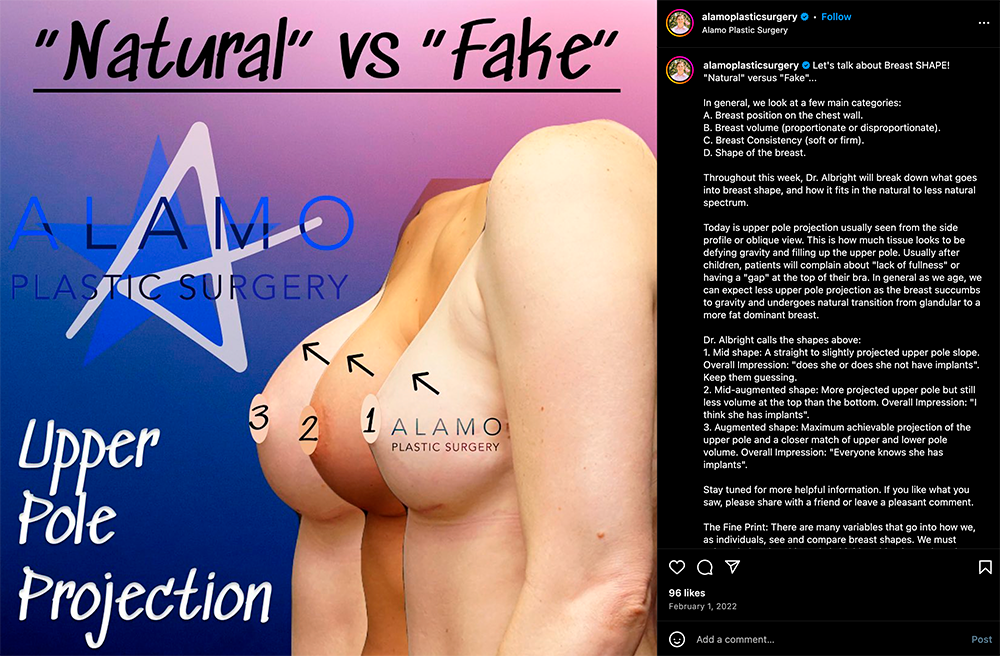
Let's talk about Breast SHAPE! In general, we look at a few main categories:
A. Breast position on the chest wall.
B. Breast volume (proportionate or disproportionate).
C. Breast Consistency (soft or firm).
D. Shape of the breast.
Upper pole projection (how far outward is the breast) usually seen from the side profile or oblique view. This is how much tissue looks to be defying gravity and filling up the upper pole. Usually after children, patients will complain about "lack of fullness" or having a "gap" at the top of their bra. In general as we age, we can expect less upper pole projection as the breast succumbs to gravity and undergoes natural transition from glandular to a more fat dominant breast.
Dr. Albright calls the shapes above:
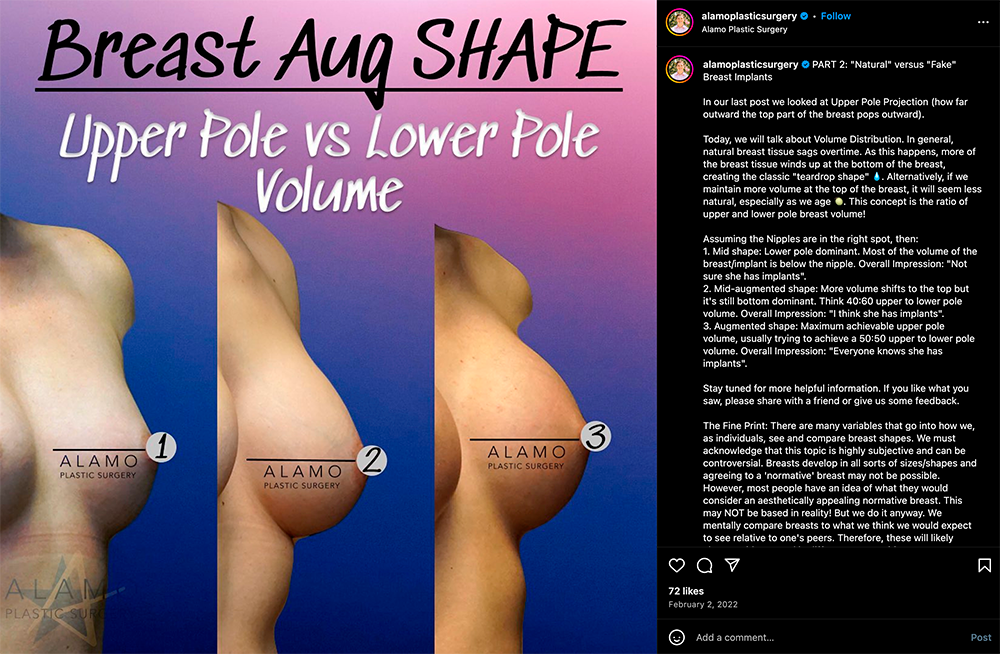
In this section, we talk about Volume Distribution. In general, natural breast tissue sags overtime. As this happens, more of the breast tissue winds up at the bottom of the breast, creating the classic "teardrop shape" . Alternatively, if we maintain more volume at the top of the breast, it will seem less natural, especially as we age. This concept is the ratio of upper and lower pole breast volume!
Assuming the Nipples are in the right spot, then:
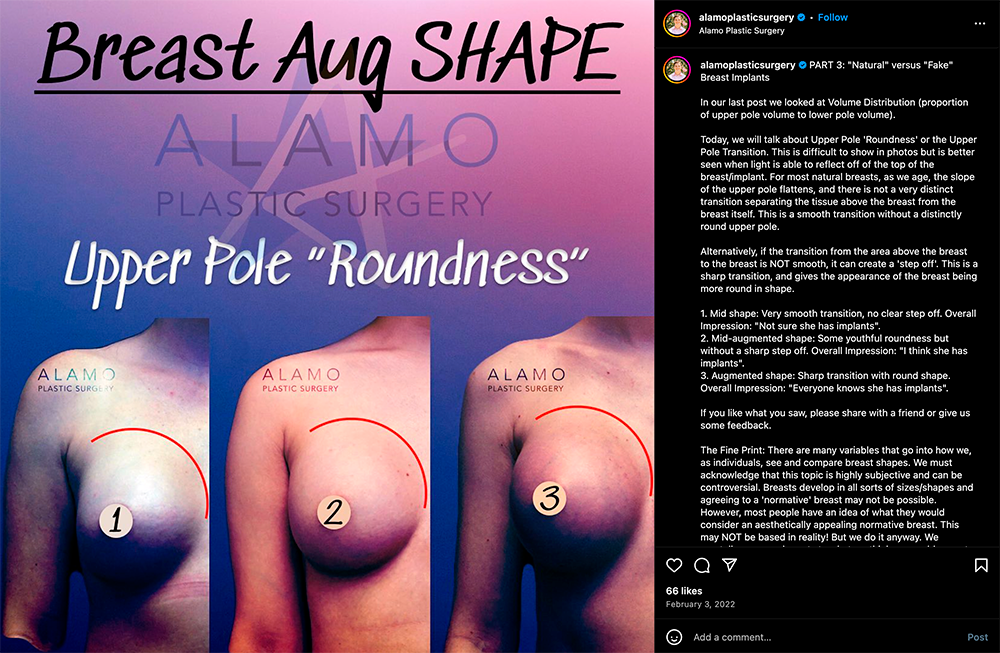
Today, we will talk about Upper Pole 'Roundness' or the Upper Pole Transition. This is difficult to show in photos but is better seen when light is able to reflect off of the top of the breast/implant. For most natural breasts, as we age, the slope of the upper pole flattens, and there is not a very distinct transition separating the tissue above the breast from the breast itself. This is a smooth transition without a distinctly round upper pole.
Alternatively, if the transition from the area above the breast to the breast is NOT smooth, it can create a 'step off'. This is a sharp transition, and gives the appearance of the breast being more round in shape.
The Fine Print: There are many variables that go into how we, as individuals, see and compare breast shapes. We must acknowledge that this topic is highly subjective and can be controversial. Breasts develop in all sorts of sizes/shapes and agreeing to a 'normative' breast may not be possible. However, most people have an idea of what they would consider an aesthetically appealing normative breast. This may NOT be based in reality! But we do it anyway. We mentally compare breasts to what we think we would expect to see relative to one's peers. Therefore, these will likely change with age and in different communities.
Dr. Albright's Perspective
"Most patients don't come to us asking for a 'fake' appearance. They want results that enhance their natural proportions while still looking like themselves. The best breast augmentation outcomes are achieved when implant selection is customized to the patient's anatomy, lifestyle, and personal goals."
Yes. Modern breast augmentation techniques can create very natural-looking results when implant size, shape, placement, and a patient's anatomy are carefully considered. The goal for many patients is enhancement that complements their natural proportions rather than creating an obviously augmented appearance.
There is no single implant size that looks natural for everyone. The most natural-looking result depends on factors such as your body frame, chest width, existing breast tissue, and aesthetic goals. An implant that appears subtle on one patient may look significantly different on another.
Many patients and surgeons feel that silicone implants tend to have a softer, more natural feel compared to saline implants. However, both implant types can produce attractive results when properly selected and placed. The best option depends on your anatomy, preferences, and surgical goals.
Not necessarily. Patients who choose implant sizes and profiles that complement their natural proportions often achieve results that are difficult for others to identify as breast augmentation. More dramatic implant sizes or greater upper pole fullness may create a more noticeably augmented appearance.
Choosing the right implant size involves more than simply selecting a cup size. During a consultation, factors such as body proportions, breast dimensions, skin elasticity, lifestyle, and desired appearance are evaluated to help determine which implant option is most appropriate for your goals.
The difference between a natural-looking and more obviously augmented breast appearance often comes down to a combination of implant size, volume distribution, upper pole fullness, and individual anatomy. There is no single "right" look, and aesthetic preferences vary from patient to patient.
Understanding these concepts can help you communicate your goals more effectively and make informed decisions about breast augmentation. For patients who would like to continue researching their options, Dr. Albright's colleague, Dr. Kamran Azad, has created a breast augmentation guide that provides additional information about implant selection and breast enhancement procedures.
If you have questions about your options or would like personalized guidance, consulting with a board-certified plastic surgeon can help determine the approach that best aligns with your anatomy and desired outcome. We invite you to contact our office to learn more or schedule a consultation.